Gitta Honegger:Well, let’s start at the very beginning. What propelled you to write this play?
Elfriede Jelinek: The thought that I’ve got to do something about [Donald Trump]. And I had to work fast. I can’t do it otherwise, it is an inner restlessness. I can’t just wait and then fiddle around with it – I write [one text] several times, this is already the tenth version, that is, I keep writing over the previous one, like [the Austrian painter] Arnulf Rainer, who paints black over everything. I write over everything until I have the feeling, that’s it. And now as new men keep entering the scene, I worked in a few more things I didn’t know before. The first version was so quick, it wasn’t known yet what people he would pick, that’s why this version got to be much longer.
Why?
This thought that he did want to become president as an athletic competition, but did not want to be it, because it’s a lot of work and he is extremely lazy, too lazy to think and generally lazy and that he would shy away from such work, but I was wrong.
But it’s still too soon to tell whether you were right or not.
I think that he wanted to become it, but he did not want to be president. Maybe [Jared] Kushner and his daughter convinced him, they’d like to get into act…well, for me it was quite logical and conclusive, the brief text I wrote and now I think that I wasn’t right at all and this play is, of course, a further attempt, an association to it, as I take the great Oedipus, who preoccupied so many, be it psychoanalysis, be it Greek drama, that is, a superhumanly great figure, that is: guiltless, the guiltlessly guilty one in Western cultures, that I take this great figure, so to speak, who Freud has written about and René Girard and practically everyone has something to say about, that I am taking him down to such a pathetic wretch as Trump, who really is a disgraceful person, dumb, unenlightened, and actually, in the Freudian sense I would call him an Id that never developed an Ego, it’s really an Id that speaks out of him, who has no Superego at all […].
When you start writing, is it meant to be an intervention or are you doing it to think through a particular issue for yourself?
It is both. I clarify things for myself and I also associate them with my own biography, and on the other hand, I have the sense to possibly stir up someone, but that’s ludicrous, for who will come to the theater? It is preaching to the choir. That’s always a big problem, political theater cannot overcome and this is why aesthetically I want to bring it up to a level where it is right.
And how can this be done aesthetically?
By applying the utmost I am capable of linguistically, well, this is my method, which works with the sound of words to over-the-top punning, that is, with language itself, so I use everything I’ve got and go as far as I can go linguistically, and if that is right the political is too. It would no longer work, if I had a political objective and did this with the aesthetics of educational broadcasting or agitprop, though agitprop, taking theater out into the streets could be relevant again.
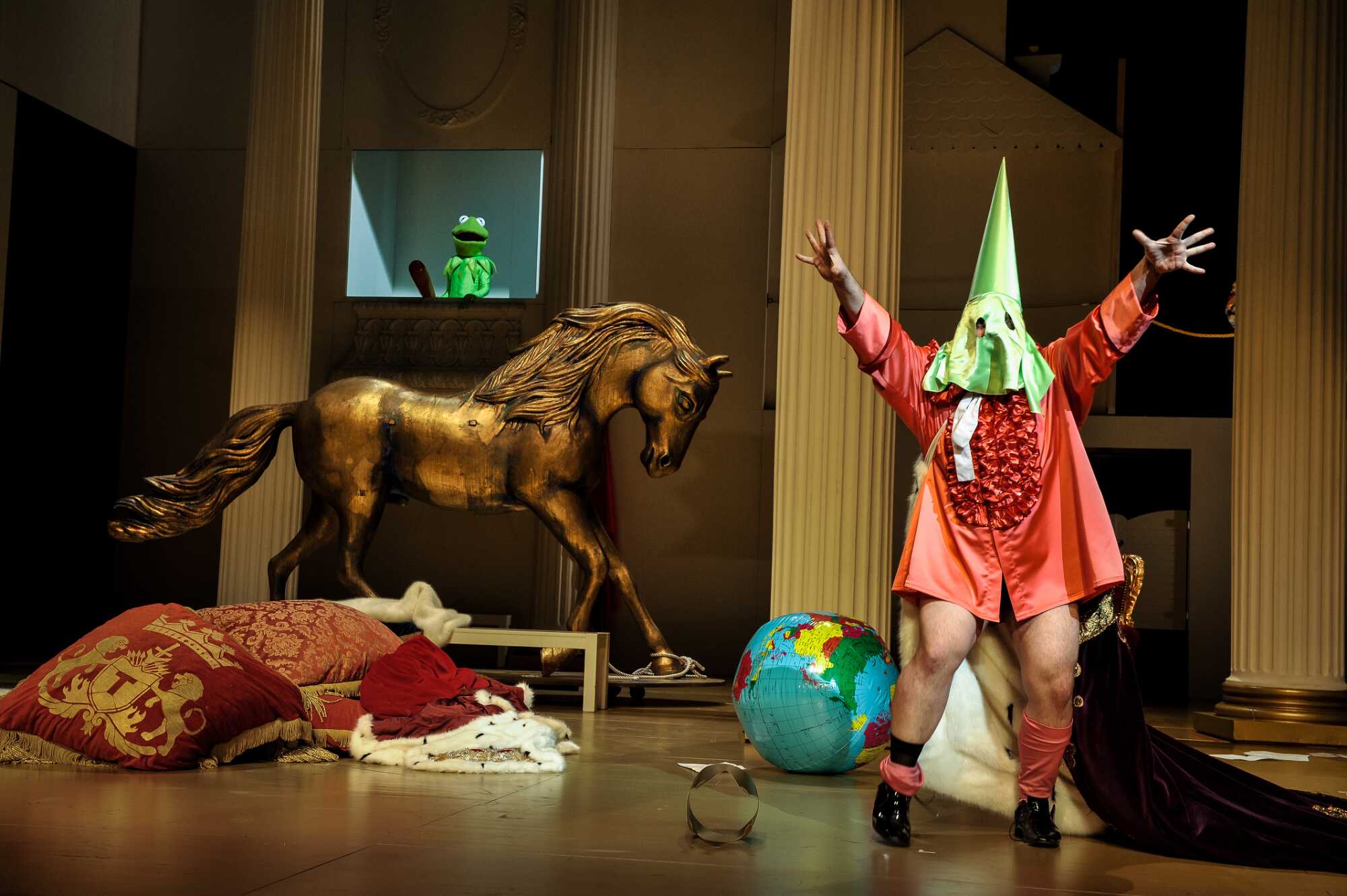 Uraufführung am Deutsches SchauSpielHaus Hamburg, 2017. Foto: Deutsches SchauSpielHaus / Arno Declair



Am Königsweg ist eine Überarbeitung von Jelineks bislang unveröffentlichtem Theatertext
Der Einzige, sein Eigentum (Hello darkness, my old friend) (2017)
.
Anlass von Am Königsweg war der Sieg
Donald Trumps
bei der amerikanischen Präsidentenwahl 2016 (
Politik
). Der Theatertext setzt sich mit den Folgen von
Kapitalismus
und
Globalisierung
und dem damit in Zusammenhang stehenden weltweiten Erstarken des
Rechtspopulismus
auseinander und fragt nach Schuld und Verantwortung.
Der Text ist durch Absätze und Leerzeilen gegliedert und nicht auf SprecherInnen aufgeteilt, im letzten Drittel tritt „Eine andere, die ausnahmsweise aus dem Mund blutet“, als Sprecherin auf. Die dem Text vorangestellte Regieanweisung gibt Figuren wie Miss Piggy oder Kermit aus der Muppet Show (
Pop-Kultur
) an.
In Anlehnung an den verarbeiteten Intertext,
Sophokles
König Ödipus (
Antike
), geht es um einen König. Wie in
Sophokles
ʼ Stück nur das Opfer Ödipusʼ die Einheit der Gemeinschaft wiederherstellen kann, wird auch in Jelineks Theatertext ein Gewaltexzess (
Gewalt
) prophezeit, der, unter Bezugnahme auf
René Girards
Das Heilige und die Gewalt , den König als sühnendes Opfer fordern wird.
Aus dem antiken Stoff übernimmt Jelinek neben Motiven wie Blindheit und Blendung auch das des blinden Sehers, der die drohende Katastrophe zwar vorhersehen, ihrem Eintreten jedoch nur ohnmächtig zusehen kann. Das Motiv wird u.a. mit der Krise der intellektuellen Linken verknüpft, die in der Ära der Postfaktizität kein Gehör mehr finden, und der Position als Schriftstellerin. Thematisiert werden darüber hinaus die zunehmende Spaltung der
Gesellschaft
sowie die wachsende Unzufriedenheit als Folge von Finanzkrise, Globalisierung und
Fremdenfeindlichkeit
. Unter Bezugnahme auf
Heideggers
Philosophie
entlarvt der Text diese Mechanismen als „das gute Alte“, das nun in der Verkleidung des Neuen wiederkehrt.
David Cay Johnston
: „Die Akte Trump“
Sophokles
: „König Ödipus“
René Girard
: „Das Heilige und die Gewalt“
Martin Heidegger
, wie immer, diesmal „Die Schwarzen Hefte“, einige Stellen geschwärzt.
David Graeber
: „Schulden““
Am 7.1.2021 veröffentlichte Jelinek auf ihrer Website eine Erweiterung des Schlusses mit dem Titel Auszüge aus „am Königsweg“, nur ein kleines Medley . Die ergänzten Passagen thematisieren die Ereignisse im Vorfeld der Inauguration von US-Präsident
Joe Biden
, insbesondere die Stürmung des Kapitols in Washington, D.C. am 6.1.2021 durch AnhängerInnen von
Donald Trump
. Ausgehend von der Gewalteskalation werden Bezüge zu
Girards
Deutung des Sündenbockmechanismus hergestellt. Intertextuelle Bezüge gibt es zu
William Shakespeares
King Lear .